
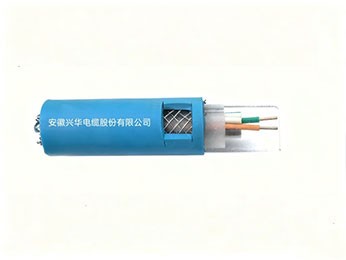
I. Product Uses and Characteristics
Polyethylene insulated braided shielded galvanized steel wire braided armored polyvinyl chloride sheathed communication cables for coal mines are mainly used in fully mechanized coal mining faces, main roadways or inclined roadways. They are heavy-duty, armored, shielded communication cables with extremely high mechanical strength, excellent anti-interference capability, and good signal transmission performance.
II. Product Standards
GB/T3956
III. Product Models and Names
Model | Name | Remarks |
MHYBV | Polyethylene insulated braided shielded galvanized steel wire braided armored poly vinyl chloride sheathed communication cable for coal mines |
Table1
IV. Product Specifications
Number of cores×Nominal conductor cross- sectional area(mm2) | Nominal insulation thickness mm | Nominal sheath thicknessmm |
Cable outer diameter upper limit mm | ||
Cross-section mm2 |
Inner sheath |
Outer sheath | |||
2.0, 2.5 | 0.75 | ||||
2 ×2.0+5 ×0.75 | 0.8 | 0.6 | 1.2 | 1.6 | 19.0 |
2 ×2.5+3 ×0.75 | 0.8 | 0.6 | 1.2 | 1.6 | 16.0 |
Table2
V. Technical Requirements
5.1 Conductor
5.1.1 The conductor structure shall comply with the provisions of Table 3, and its performance shall comply with the provisions of GB/T3956.
Table3 Conductor structure
Nominal cross-sectionmm2 | Conductor structure | Maximum conductor resistance at 20℃ Ω/Km | |
Number of wires/wire diameter | Copper conductor | Tinned copper conductor | |
0.75 (signal core) | 24/0.20 | 26.0 | 26.7 |
2.0 (power core) | 40/0.25 | 10.2 | 10.6 |
2.5 (power core) | 50/0.25 | 7.98 | 8.21 |
5.1.2 The conductor shall be annealed round copper wire. The single wires in the conductor may be tinned or untinned round copper wire. The surface shall be smooth, free from oil stains, protrusions or other defects that may damage the insulation.
5.2 Insulation
5.2.1 The insulation material shall be high-density polyethylene, and its performance shall comply with the requirements of Table 4.
Table4 Polyethylene insulation performance
Item | Technical performance |
Tensile strength N/mm2 Elongation at break % | ≥10.0≥300 |
5.2.2 The insulation shall be tightly extruded over the conductor, and the insulation shall not adhere to the conductor and shall be easily stripped.
5.2.3 The insulation thickness shall comply with the provisions of Table 2. The average value of the insulation thickness shall be not less than the nominal value, and the thickness at the thinnest point shall be not less than 90% of the nominal value minus 0.05mm.
5.2.4 The insulated cores shall be distinguished by color.
5.3 Twisting of signal core pairs
5.3.1 The signal cores shall be twisted into pairs, and the twisting pitch shall be not greater than100mm. The two insulated cores in a pair shall have different colors.
5.3.2 A layer of polyester tape may be overlapped and wrapped around the pair.
5.4 Shielding of signal cores
5.4.1 The shielding of signal cores shall be metal wire braiding.
5.4.2 The metal wire for braided shielding shall be soft round copper wire or tinned soft round copper wire, with a nominal diameter of 0.10~0.20mm. The braided layer shall be uniform, with no overall splicing. Exposed wire ends shall be trimmed smooth. One replacement of the metal wire bobbin is allowed per1 meter length. The braiding density shall be not less than70%.
5.4.3 A layer of polyester tape may be wrapped around the outside of the shielded pair, with an overlap rate of not less than 10%.
5.5 Cabling
5.5.1 The cabling shall be concentric stranding, with a pitch diameter ratio of not more than 25 times.
5.5.2 The gaps between pairs during cabling may be filled with non-hygroscopic materials.
5.6 Inner sheath and steel wire braided reinforcement
5.6.1 A PVC inner sheath shall be extruded inside the reinforcement layer.
5.6.2 The thickness of the extruded inner sheath shall comply with the provisions of Table 2, with a negative deviation of 20% allowed. The performance of the cable inner sheath shall comply with the requirements of items 1 and 2 in Table 5.
5.6.3 The reinforcement layer shall be galvanized steel wire braiding, with a nominal diameter of 0.21~0.30mm. The braiding coverage rate shall be25%~35%. The braided layer shall be uniform, with no overall splicing. Exposed wire ends shall be trimmed smooth. One replacement of the metal wire bobbin is allowed per1 meter length.
5.7 Outer sheath
5.7.1 The cable outer sheath shall be extruded from PVC compound, and its performance shall comply with the provisions of Table 5.
5.7.2 The nominal thickness of the sheath shall be as specified in Table 2.
5.7.3 The average thickness of the sheath shall be not less than the nominal value, and the thickness at the thinnest point shall be not less than 85% of the nominal value minus 0.1mm.
5.7.4 The sheath shall be tightly extruded over the cable core, and the surface shall be uniform in color, round and smooth.
5.8 Cable outer diameter
The cable outer diameter shall comply with the requirements in Table 2 (maximum outer diameter).
5.9 Finished cable
5.9.1 The cable conductor cores shall have no broken wires, short circuits between pairs, or mixed wires.
5.9.2 The DC resistance difference of the working pairs of the cable shall be not greater than 2% of the loop resistance.
5.9.3 AC voltage withstand performance: The cable shall withstand a 1.5kV AC voltage test for 1 minute between insulated cores and between insulated cores and shielding,
with no breakdown or flashover permitted.
5.9.4 The inherent attenuation of the cable signal working pairs at 800Hz shall be not greater than1.1dB/km.
5.9.5 The working capacitance between the signal cores of the cable at a test frequency of800Hz shall be not greater than0.10μF/km.
5.9.6 The far-end crosstalk attenuation between any two pairs of cores in a500m length of cable shall be not less than70dB.
5.9.7 The inductance of each core of the cable signal line in a1.0km length shall be not greater than800μH.
5.9.8 Low temperature static bending performance: The cable shall withstand a low temperature static bending test. The test temperature is-40℃. After the test, there shall be no visible cracks or openings on the cable surface.
5.9.9 Low temperature impact test: The cable shall withstand a low temperature impact test. The test temperature is-10℃. After the test, the cable surface shall show no damage, and there shall be no open circuits or short circuits between cores.
5.9.10 Low temperature tensile test: The MHYVP cable shall withstand a low temperature tensile test. The test temperature is-10℃.
5.9.11 High temperature test: The cable shall withstand a high temperature test. After the test, there shall be no visible cracks or openings on the cable surface.
5.9.12 Damp heat test: The cable shall withstand a damp heat test. The high humidity temperature is+40℃, with a cycle of 6 days. Immediately after the test, the insulation resistance shall be not less than 100MΩ·km, and the power frequency voltage withstand between cores shall be1.5kV for1min without breakdown, and the cable surface shall have no wrinkles, bubbles, or cracks.
5.9.13 Flame retardant performance: The flame retardant performance of the cable shall comply with the test requirements specified in GB43069-2023, sections 5.4.2 and 5.4.3.
5.9.14 The lead and arsenic content of the cable materials shall comply withGB43069-2023, section 5.5.1.
5.9.15 Delivery length:
1. The cable may be delivered in lengths specified by the user, with the delivery length generally not exceeding1000m;
2. The cable delivery length shall be not less than100m. Short lengths of cable less than50m shall not exceed 10% of the total delivery quantity. The length measurement error shall be not greater than±0.5%;
3. If the user has special requirements for delivery length, delivery may be made according to the length agreed upon by both parties.
Table5 Main properties of PVC sheath
No. | Item | Technical performance |
1 | Mechanical properties Tensile strengthMPa Elongation at break% |
≥12.5≥150 |
2 | Mechanical properties after aging Treatment conditions: Temperature℃ Timed Tensile strengthN/mm2 Change rate of tensile strength%Elongation at break% Change rate of elongation at break% |
80±2 7 ≥12.5≤±25≥150≤±25 |
3 | High temperature pressure test Test temperature℃ Indentation depth% |
80±2≤50 |
No. | Item | Technical performance | |
4 | Low temperature performance test Low temperature impact test Test temperature-15℃(tolerance±2℃)Low temperature winding test Test temperature-15℃(tolerance±2℃)Low temperature tensile test Test temperature-15℃(tolerance±2℃) |
No cracking
No cracking
≥20 | |
5 | Anti-cracking Test temperature Duration |
150℃(tolerance±3℃)1h |
No cracking |
5.9 Product testing
The finished cable shall be tested in accordance with Table7 to verify compliance with the corresponding requirements.
5.10 Delivery length
5.10.1 The cable delivery length shall be not less than 100m. Short lengths of cable not less than 20m are allowed for delivery, but the quantity shall not exceed 10% of the total delivery quantity.
5.10.2 The length shall be measured with a length meter, with an allowable error of ±0.5%.
5.10.3 The delivery quantity of the cable is allowed to be ±10% of the contract quantity. According to the agreement of both parties, cables of any length may be delivered.
6 Test methods and inspection rules
6.1 The product shall be inspected and approved by the manufacturer's quality inspection department before leaving the factory, and each delivered product shall be accompanied by a product certificate.
6.2 The product shall be tested in accordance with the provisions of 5.9. The test categories are divided into: Type Test (T), Sample Test (S), and Routine Test (R).
6.3 Sampling method
6.3.1 Sample test samples shall be randomly selected from the delivery batch. The quantity of each sample shall meet the test requirements, and the number of samples shall comply with the provisions of Table 6.
Table6 Number of sample samples
Delivery batch quantity L(km) | Number of samples |
L≤1 1≤L≤55≤L≤10 | 1 2 3 |
6.3.2 If the first test result is unqualified, double the number of samples shall be taken for re-inspection of the unqualified item. If it still fails, the batch of cables shall be judged as unqualified.
6.4 The product appearance shall be inspected visually (with normal vision).
7 Packaging and marking
7.1 The cable shall be delivered on reels or in coils, wound neatly, with the cable ends sealed. The delivery piece shall have outer packaging.
7.2 The cable delivery reel shall comply with the provisions of JB/T8137.
7.3 Each package shall be attached with a label indicating:a Manufacturer's name; b Model and specification; c Length m;d Weight kg; e Date of manufacture; f Standard number.
 Table7 Test methods and inspection rules
No. | Item name | Performance requirement clause number | Test type | Test method |
Standard number | ||||
1 | Electrical performance test | |||
1.1 | Conductor DC resistance | 5.1.2 | T,S | GB/T3048.4 |
1.2 | DC resistance difference | 5.9.2 | T,S | GB/T3048.4 |
1.3 | Conductor core continuity test | 5.9.1 | T,R | MT/T818.14 |
1.4 | Insulation resistance | 5.2.3 | T,R | GB/T3048.5 |
1.5 | AC voltage test | 5.9.3 | T,R | GB/T3048.8 |
1.6 | Working capacitance | 5.9.5 | T | GB/T5441 |
1.7 | Inherent attenuation | 5.9.4 | T | GB/T5441 |
1.8 | Crosstalk attenuation performance | 5.9.6 | T | GB/T5441 |
1.9 | Inductance | 5.9.7 | T | MT/T818.14 |
2 | Structure and surface marking | |||
2.1 | Surface marking | 7.3 | T,S | MT/T818.14 |
2.2 | Cable outer diameter | 5.9 | T,S | GB/T2951.11 |
2.3 | Insulation thickness | 5.2.3 | T,S | GB/T2951.11 |
2.4 | Sheath thickness | 5.7.3 | T,S | GB/T2951.11 |
3 | Insulation mechanical properties | 5.2.1 | T | GB/T2951.11 |
4 | Sheath mechanical properties | |||
4.1 | Mechanical properties before aging | 5.7.1 | T | GB/T2951.11 |
4.2 | Heat aging test | 5.7.1 | T | GB/T2951.12 |
5 | Low temperature performance test | |||
5.1 | Low temperature static bending test | 5.9.8 | T | MT/T818.14 |
5.2 | Low temperature impact test | 5.9.9 | T | GB/T2951.14 |
5.3 | Low temperature tensile test | 5.9.10 | T | GB/T2951.14 |
6 | High temperature test | 5.9.11 | T | MT/T818.14 |
7 | Damp heat test | 5.912 | T | MT/T818.14 |
8 | Flame retardant performance | |||
8.1 | Single vertical combustion test | 5.9.13 | T,S | GB43069 |
8.2 | Bunched combustion test | 5.9.13 | T | GB43069 |
9 | Lead and arsenic content of cable materials | 5.9.14 | T | GB43069 |
10 | Delivery length | 5.12.16 | R | Length meter |
If you are interested in our products, or want to ask related questions, please leave a message to us.
We will reply and serve you as soon as possible. Thank you for visiting our official website.